Conclave
A Windows app where a panel of seven AI agents researches your question on the live web, argues it out and votes, then a chair writes a cited report.
Ask a single AI a hard question and you get one confident answer. Conclave asks seven. You bring it a question or a request for ideas, and a panel of AI agents researches it on the live web, argues it out and votes. A chair then writes a report with sources, ready to export as PDF, Word, slides or Markdown.
Conclave is a concept by Vorelyn Studios, and currently a working prototype.
Seven minds, one chair
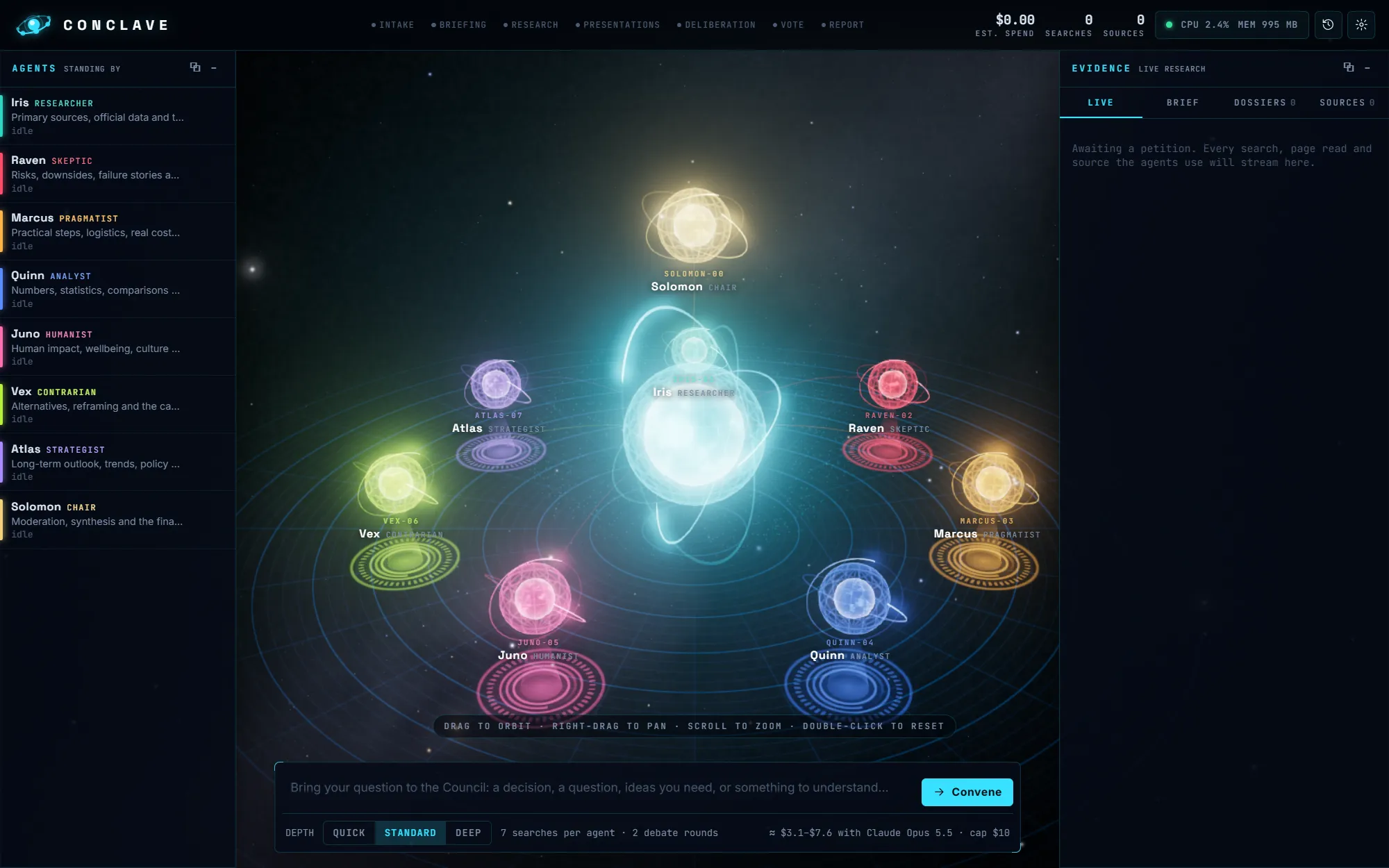
Each agent looks at the problem from a different angle, and each is told to attack the weak spots in the others’ arguments.
- Iris, the Researcher, goes to primary sources and official data, and rates how strong each piece of evidence is.
- Raven, the Skeptic, hunts for weak claims, missing evidence and wishful thinking, and is the hardest to convince.
- Marcus, the Pragmatist, asks about real costs, steps, timelines and the experience of people who have done it.
- Quinn, the Analyst, works in numbers, base rates and comparisons, and challenges any figure without a source.
- Juno, the Humanist, asks who is affected and who carries the risk.
- Vex, the Contrarian, questions the framing and raises the alternatives nobody considered.
- Atlas, the Strategist, looks at the long term: trends, policy and knock-on effects.
Solomon, the Chair, doesn’t vote. He sizes up the question, gives each agent its research task, keeps the debate honest, drafts the verdict and writes the report.
Sized to the question
Before any research starts, the Chair decides what kind of request it is. A question or decision gets a researched verdict. A request for ideas gets a brainstorm, where the panel proposes ideas, stress-tests them and agrees a shortlist, each with the cheapest first experiment to try it.
He also decides how much work it needs. A simple factual question is answered by one agent and checked against sources, with no debate. A focused question gets a panel of three or four that always includes a challenger. A consequential decision gets all seven. A depth setting of Quick, Standard or Deep caps how far he can go, and a spending cap stops a session from running past its budget.
A debate that’s meant to be tough
The agents research independently, and every search, page and source appears in a live feed as it happens. Then they present their findings and cross-examine each other. Any agent can challenge any other, open challenges are tracked, and an agent with unanswered challenges has to answer them before making new points. The panel votes aloud until it agrees or the rounds run out, and anyone voting against has to say what would change their mind.
You stay in control throughout. Type a question at any moment and the speaking agent stops so the panel can answer you. Stop the session and everything freezes at once; you can continue, have the Chair write a report from the evidence so far, or end it.
Every citation checked
The report opens with the verdict and covers the findings with confidence ratings, the options compared, risks rated by likelihood and impact, next steps, the limits of the evidence, the vote and every source. An agent can only cite a page it actually retrieved in that session, so every source in the report is one the panel really read.
Any engine, mixed models
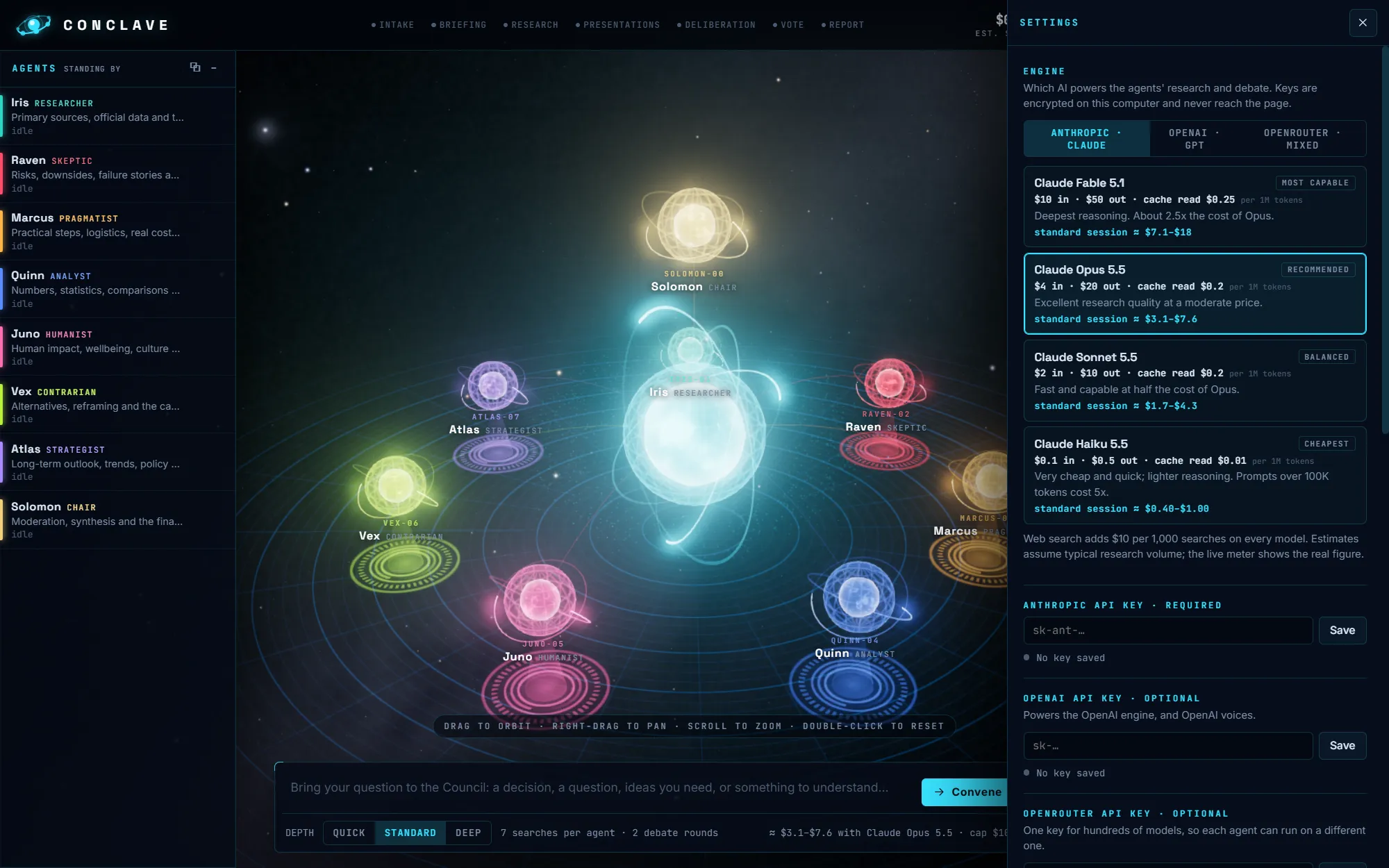
Conclave runs on the AI service you connect: Anthropic, OpenAI or OpenRouter, using that service’s models. With OpenRouter, each agent can run on a model from a different provider. Different models have different blind spots, which makes the debate sharper. Voices are optional, and each agent can have its own.
Built to be trusted
API keys are encrypted with Windows’ own protection and are only ever used by the app’s background process, never the visible interface. The interface runs sandboxed and can’t reach the internet itself, and the agents treat web pages as evidence, never as instructions.
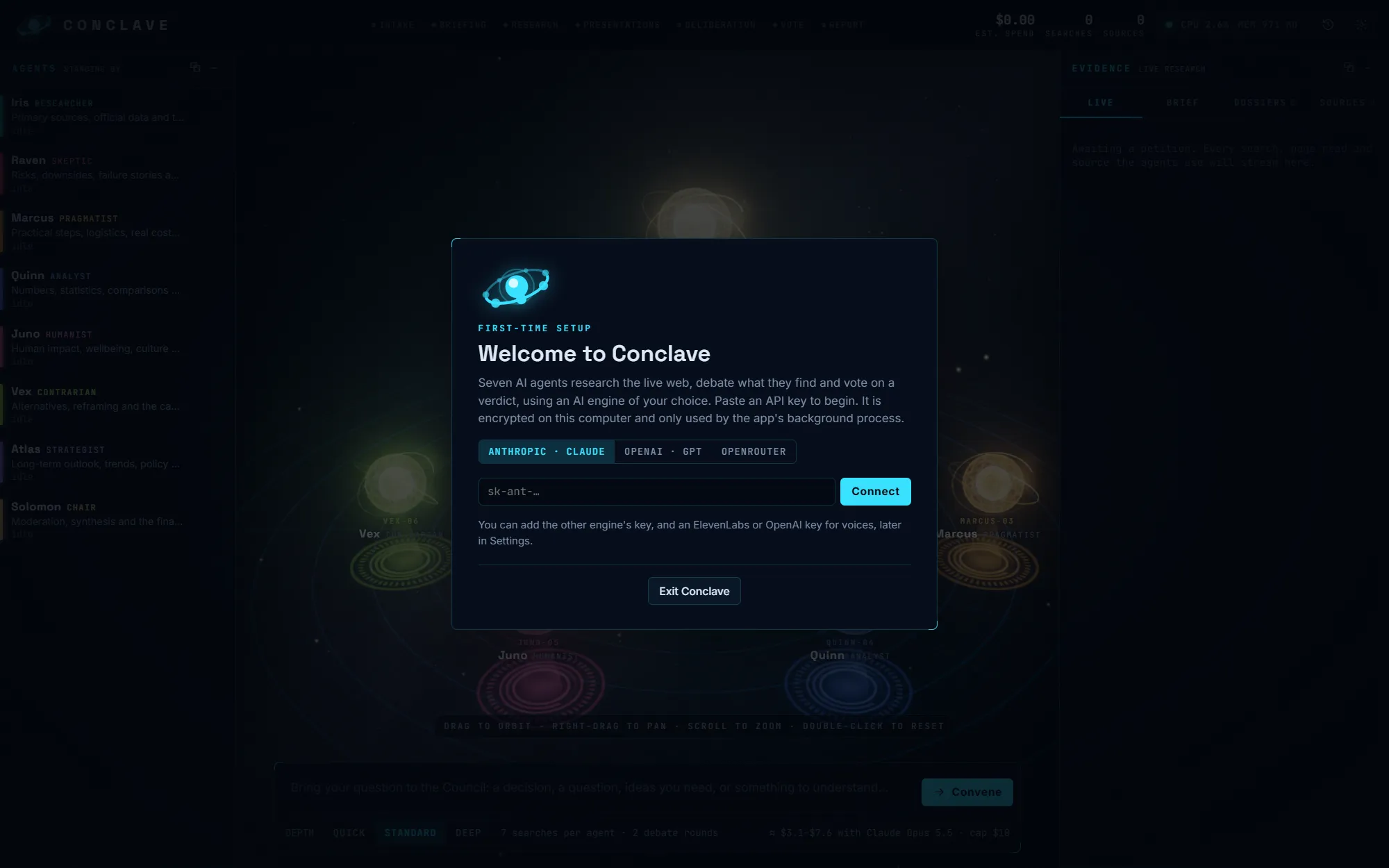
The scene
We designed Conclave to feel like convening a council rather than using a chat box. The panel floats in deep space as glowing figures around the Chair, and you can orbit, zoom and drag around them. Around the scene sit a timeline of the session’s stages, the agent and evidence panels, and cards for each presentation, pitch and draft.
Nothing hidden
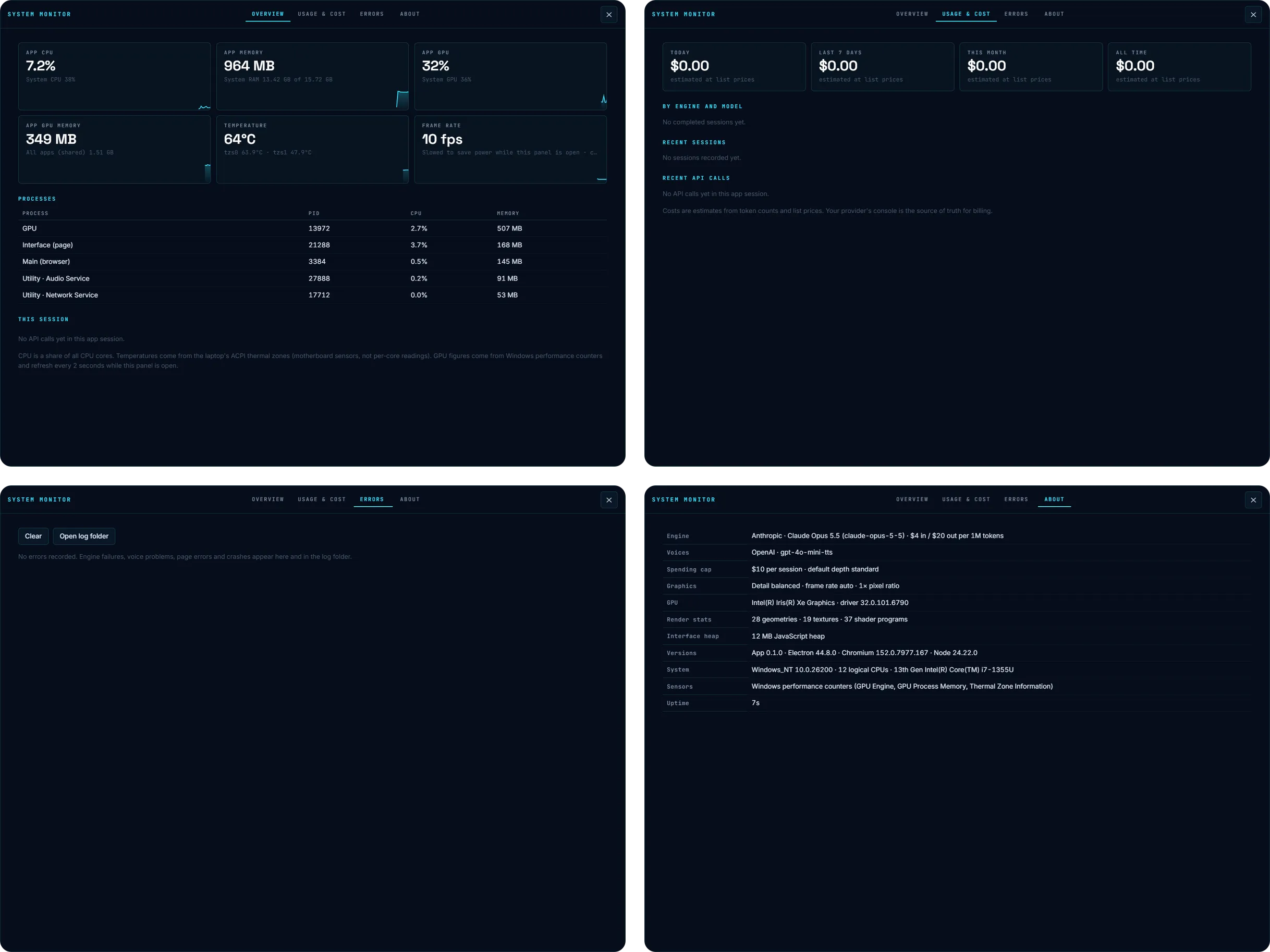
A built-in system monitor shows what the app is doing as it works: CPU, memory, GPU, temperature and frame rate, plus spending by day, model and session, and a log of any errors. A session’s cost is never a surprise.